 Email: info@sientechnology.com
 HOME
HOME
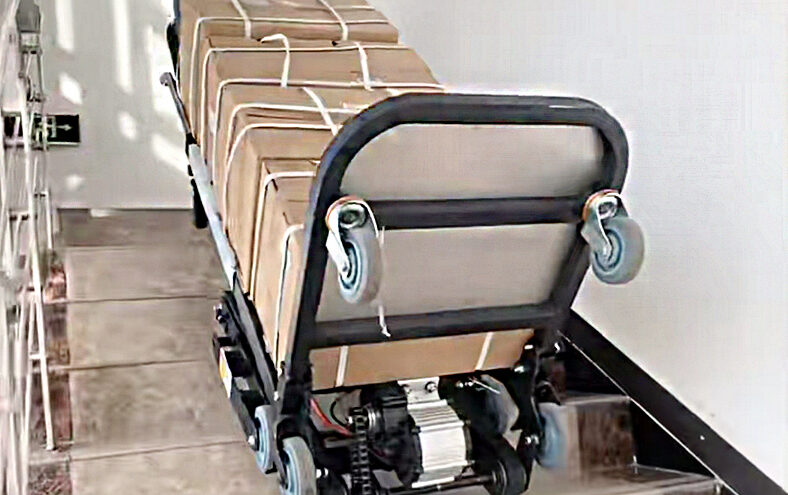
How to Choose the Right Electric Stair Climbing Truck
In logistics, distribution, and industrial environments, moving heavy objects up and down stairs is one of the most challenging tasks. Traditional manual handling is not only inefficient but also risky. Long-term reliance on manual labor requires significant investment in manpower and is prone to workplace injuries such as back sprains and injuries from falling objects, placing additional economic burdens and compliance risks on businesses.
Electric stair climbing trucks offer a safer, faster, and more economical solution. With their flexibility, convenience, and single-person operation capabilities, they have become a core tool for solving the problem of moving heavy objects in stairwells in industries such as logistics and distribution, appliance installation, and warehouse operations, helping companies reduce costs, increase efficiency, and mitigate safety hazards.
Why You Need an Electric Stair Climbing Truck
For businesses that frequently handle heavy objects in stairwells, an electric stair climbing truck is not just an optional piece of equipment, but an essential tool for improving operational efficiency and ensuring work safety. Its core value lies in three points:
- Reducing manual labor input and lowering labor costs
- Improving work efficiency and shortening turnaround time
- Enhancing safety and reducing the risk of workplace injuries
Key Considerations
The market offers a wide variety of electric stair climber models with significant performance differences. Blindly choosing one can lead to wasted costs or failure to meet operational needs. The following five core factors should be considered:
- Load Capacity
Load capacity is the core indicator for selecting an electric stair climber. It must be precisely selected based on the company’s actual handling requirements to avoid overloading or wasting performance:
- 100–150kg: Suitable for light delivery scenarios, such as express parcels, small appliances, food boxes, etc., suitable for express logistics, community delivery, etc.
- 200–300kg: Suitable for standard uses, such as medium-sized appliances, small warehouse goods, small building materials, etc., suitable for appliance delivery, warehouse operations, etc.
- 300kg+: Suitable for industrial applications, such as large appliances, heavy building materials, large warehouse goods, etc., commonly used in industrial production, large construction sites, etc. Staircase Type Compatibility
The type of staircase in the work environment directly affects the performance of the electric stair climber. Before purchasing, confirm that the equipment is compatible with common staircase types:
- Straight staircase
- Spiral staircase
- Narrow staircase
- Battery Performance
Battery performance directly determines the continuous operation of the electric stair climber, especially suitable for enterprises with high-frequency operations. A high-quality battery must meet two requirements:
- Longer operating time
- Stable performance
- Wheel Design
Wheel design affects the stability, smoothness, and safety of the equipment. Different wheel structures are suitable for different scenarios. Focus on three key points:
- Stability
- Smoothness
- Safety
- Manufacturing Quality
Electric stair climbers are high-frequency industrial equipment. Manufacturing quality determines service life and failure rate. Focus on three key points:
- Robust frame
- Durable materials
- Reliable motor
Common Purchasing Misconceptions
Many companies fall into the following three misconceptions when choosing electric stair climbers, leading to idle equipment, wasted costs, or safety hazards. These should be avoided:
- Choosing solely based on price: Low-priced equipment often suffers from insufficient load-bearing capacity, short battery life, and high failure rates, ultimately increasing maintenance costs and safety risks in the long run;
- Ignoring staircase type: Failing to consider the type of staircase in the work environment results in equipment that cannot turn or pass through, leading to idleness;
- Neglecting after-sales support: Electric stair climbers inevitably experience malfunctions with prolonged use. Inadequate after-sales support can lead to untimely repairs, impacting work progress.
Application
Electric stair climbers, with their flexibility, efficiency, and safety, are widely used in various industries. Core application scenarios include:
- Appliance Delivery: Delivering appliances such as refrigerators, washing machines, and air conditioners upstairs, requiring only one person and improving delivery efficiency;
- Warehouse Operations: Handling goods in warehouse lofts and multi-story warehouses, solving the problem of transporting goods in areas without elevators;
- Construction Sites: Transporting building materials such as cement, tiles, and pipes upstairs, reducing the risk of workplace injuries and improving construction efficiency;
- Logistics Companies: Moving express parcels and large items in stairwells, suitable for older residential areas and buildings without elevators.
Conclusion
Choosing the right electric stair climber can significantly improve operational efficiency and safety, while reducing labor costs and mitigating workplace injury risks, supporting efficient and stable business operations. When choosing, it is necessary to consider your own work scenarios and handling needs, focusing on core factors such as load-bearing capacity and staircase compatibility, and avoiding common purchasing mistakes to select the most suitable equipment.
Call to Action (CTA)
Contact us now for a customized stair climbing solution.
Get a free quote within 24 hours.
